Combatting Spring Frosts in the Vines
Spring cold snaps bring late frosts and vines suffering from low temperatures risk losing their buds. As a consequence winegrowers could lose some or all of their production. Below I look at a few techniques we use to fight against vine freezing. One of my guiding friends, who also manages viticultural work, has been out before first light in the last few days putting some of these techniques in place. Robert, the vineyard director at the Chateau group I managed, told me decades ago that we must wait until the passing of the Ice Saints (May 11, 12 & 13). As until then we have often observed a swift return of cold, destructive nights. If the sun is shining in March/April, it’s best to prepare! At our country mill, we won’t be using any of the following vineyard techniques to warm our wisteria: we will enjoy it today, hoping it won’t get frost burnt again this Spring! And our new “crazy” shutter colour perhaps makes sense now?

The climate emergency is also driving the fight against frost. In spring as temperatures rise, the first leaves and buds appear: earlier now due to the effects of climate change. Buds can withstand up to -3°C, but beyond that, they risk freezing: the sap, rich in water, will freeze, and “burn”, as winegrowers say, the embryonic tissues of the flower or leaves.
Small wind turbines
They are used as air mixers. These small (approx. 11m high) wind turbines stir the air above the vines and this slightly warmer air warms the vines below. There are many of these in our Pomerol wine appellation.

The principle is to warm the cold, denser air located at the level of the buds, by mixing it with warmer air present just a few meters higher, where the blades of the wind turbine are located. The thermal gain is generally 1°C, and 3°C if this mixing is combined with additional heating (see below). The advantages are numerous: little labor and monitoring, protection down to about -4°C, automated activation, non-polluting (excluding noise pollution). But this mixing is not really effective against advection frost, when a mass of cold air (below freezing point) invades an area. Advection frost gives black frost when damaged vegetation takes on a blackened appearance. France experienced this in April 2021. Turbines are ineffective against severe frosts (-6 to -7°C). and mixing is also effective only with low wind speeds (less than 8 km/h). Turbines are quite expensive (€40,000 - €47,000 to cover about 12 acres).
Warming the vines
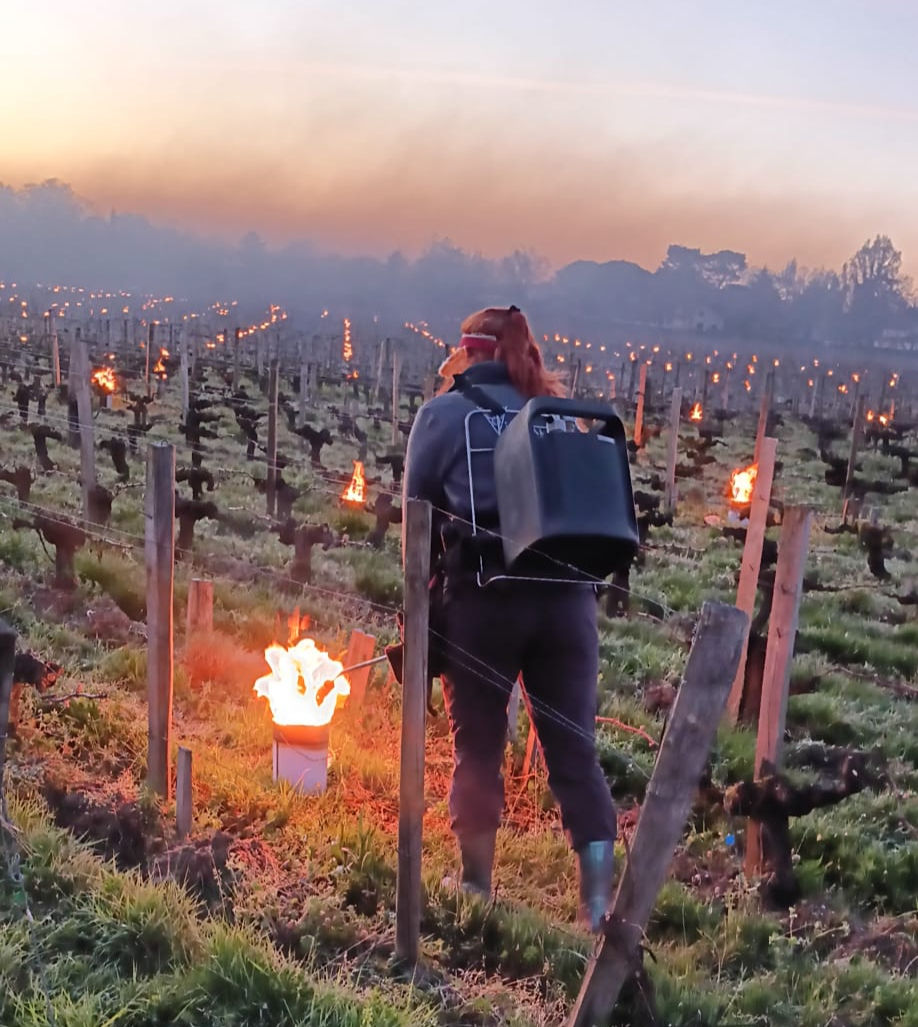
To combat frost, we have to warm the air around the vines. One of the most widespread practices is the use of big candles or braziers. The former method consists of placing large natural wax candles and blocks of paraffin in metal boxes in the vineyard. We can also use braziers placed in the middle of the vines. Candles and braziers will warm the ambient air around the vines. Both require a lot of manual labor. A beautiful nighttime spectacle perhaps but not really environmentally friendly, due to carbon dioxide emission.
This protection by heating can be combined with wind turbines. Candles allow a gain of 2.5°C but you need about 800 candles/acre.
Burning straw bales can also be used, aiming to create an opaque veil limiting a too rapid heating at sunrise (magnifying glass effect) and the radiation of the ground. Its advantage is its low cost but it requires monitoring. And we need wind from the right direction. If there is no wind the column of smoke rises vertically and does not spread above the vine, like a protective screen. In addition, you have to water the bales to make a thick smoke.
A candle lasts 10 hours and it can be put out whenever we want, a burning bale of straw is more difficult to put out and use again. In addition there is visual and olfactory pollution, and the requirement for a night watch.
Helicopters
Some winegrowers even use helicopters to mix the air. A helicopter flying at low altitude (below 20m or so) stirs and heats the air above the ground. The air near the vines is therefore warmer, preventing frost. This is a relatively hazardous operation, carried out in dawn’s low light conditions. It is also expensive. But it has been used in some of the top Bordeaux Chateaux.
Late pruning in March
Late pruning may reduce the risk of frost damage. But by pruning in January and postponing the cleaning of the stems (dis-budding) to March/April, we may also reduce the risk.
Pruning in March does seem to reduces the risk of frost damage. But for winegrowers who cannot implement this practice for organizational reasons, there is an alternative: prune in January then postpone the cleaning of the *astes (disbudding) to March/April. According to tests carried out in Libourne by members of the Economic and Environmental Interest Group (GIEE) "Adaptation to climate change", this can also slow down the stages of development of the vine and therefore mitigate frost damage.
*Technical term explanations: Astes and two types of dis- or de-budding
The aste is the wood from the previous year spared by the pruner. Each bud on the stem will give birth to a branch. Each of these branches will bear one, or even two grape bunches. The astes can be folded in an arc or flat. Arc folding is a faster method, but its use has been gradually reduced in favour of flat folding, which allows better distribution of the grapes.
Growth-shaping debudding consists of manually removing the buds with no fruit-bearing value and/or that are judged unnecessary for a young vine's formation. Manual fruit-bearing debudding consists of removing, from both young and adult vines, buds that could potentially produce bunches from the spurs and/or branches.
What is the benefit? Growth-shaping debudding is essential in order to remove any buds that will not be necessary to shape the young vine during the subsequent winter pruning or older vine rehabilitation. Thus making it possible to limit the wood's development and its accumulation, and to reduce the number of pruning strokes and pruning wounds.


Comments